Home


Key Takeaways
- Repeated HR questions often come from unclear policies, incomplete submissions, inconsistent instructions, or limited visibility over request status.
- Clearer policies and standardised submission requirements can help employees provide the right information from the start.
- Consistent instructions and clear approval updates make it easier for employees to understand what to do and what happens next.
- Self-service access can help employees find routine HR information without needing to ask HR each time.
- For lean HR teams, reducing repeated clarification means fewer interruptions and more time for work that requires human judgement.
Introduction
Singapore SMEs rarely lose hours to one dramatic HR problem. Time disappears through small exchanges: “Which form do I use?”, “Has my manager approved this?”, “Do I need a receipt?”, or “Why is my payslip different?” When employee clarification is needed again and again, the cumulative workload can quickly grow across several HR processes. When the same questions return across leave, claims, attendance, and payroll, HR communication gaps become an operational issue.
We see clarification loops as a process problem. More reminders are rarely enough. You need to make the next step obvious, standardise the information employees provide, and give people enough visibility to resolve uncertainty themselves.
1. Make HR Policies Easier for Employees to Understand
A policy can be complete and still be difficult to use. Employees may know the leave policy but still wonder whether a half-day request needs the same notice period, which documents are required for a claim, or what happens when an attendance record is wrong.
We treat employee clarification as a sign that a policy may need more practical context. We recommend writing policies around decisions employees make: what is allowed, what evidence is needed, who approves the request, and what the deadline is. When your human resource software presents those instructions beside the workflow, you reduce the gap between reading a rule and acting on it.
Useful policy language removes interpretation. Add examples for exceptions, separate mandatory requirements from guidance, and review recurring questions. Those questions show where wording still leaves doubt.
2. Standardise What Information Employees Must Submit
Incomplete requests create predictable delays. A claim arrives without a receipt. An attendance correction omits the affected date. A leave request lacks a necessary detail. HR then chases information before anyone can make a decision.
A standard submission structure can reduce the need for employee clarification by making requirements visible before the employee submits. In an expense claim system, required fields, receipt prompts, categories, and validation rules can guide employees towards a complete request. The same principle applies to leave, attendance corrections, and employee record updates.
We advise mapping each workflow from the approver’s perspective. Ask what information the reviewer needs to decide without returning the request. Then make those fields part of the submission. When one HR person manages several processes, complete submissions mean fewer returned requests, less chasing for missing details, and fewer interruptions.
3. Keep Leave, Claims, Attendance, and Payroll Instructions Consistent
Employees should not need to remember a different set of instructions for every HR task. If leave requests go through one channel, claims through email, attendance corrections through chat, and payroll questions through another thread, people spend time remembering the process before completing it.
Consistency improves HR process clarity. We recommend aligning four things across workflows: where employees submit information, what details they need, who approves the request, and where status updates appear. The details can differ, but the experience should feel familiar.
Payroll instructions deserve particular care. Singapore employers must issue itemised pay slips to employees covered by the Employment Act, and MOM sets out the required details in its itemised pay slip requirements. When your guidance uses the same terms consistently, employees have a clearer basis for understanding what they receive.
4. Use Clearer Approval Status Updates
Many follow-ups are status checks rather than policy questions. An employee wants to know whether a manager approved a claim. A manager assumes HR is processing it. HR discovers supporting information is missing. Everyone is waiting, but nobody sees the same picture.
Clear statuses can reduce the need for employee clarification without adding more messages. Labels such as “pending manager approval”, “returned for information”, “approved”, or “processed” tell people what has happened and what happens next. The wording should show whether the employee needs to act or wait.
We also recommend showing ownership. If a request is with a manager, say so. If HR needs a document, name the missing item. If processing is complete, make that visible. This keeps HR from becoming the messenger between employees and approvers.
5. Make Common HR Information Easier to Find
Routine information should not depend on who is available in HR. Leave balances, payslip access, claim requirements, attendance correction steps, payroll timelines, and policy details are among the HR questions employees commonly ask. When answers are scattered across email, folders, and chat history, employees naturally ask again.
An employment self-service portal can give employees one place to check information that applies to them. The aim is not to make HR less human. It is to reserve human support for situations needing judgement, context, or sensitivity, while routine lookups remain easy.
How OpensoftHR’s AI-powered HR Assistant Reduces Clarification Loops
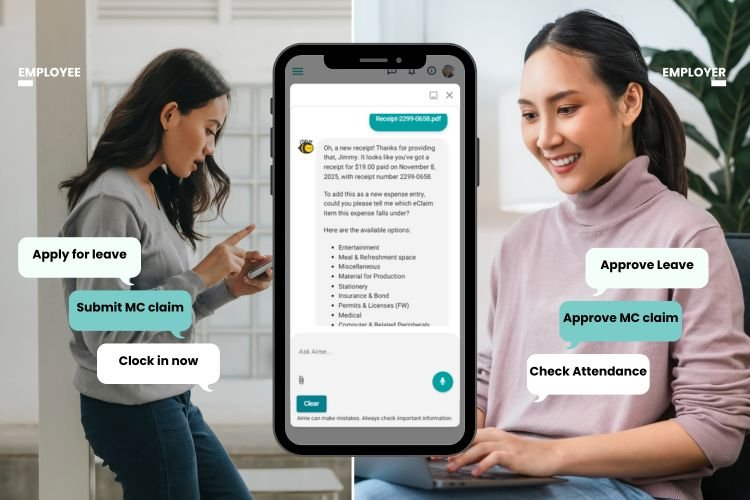 AIME, OpensoftHR’s AI-powered Employee Self-Service assistant, lets employees ask about their own leave balances, claim status, attendance records, payslip queries, and common policy questions from their devices. Because AIME is HRMS-native, employees can ask within the same HR workflow for information tied to their own record, such as a current leave balance or claim status, rather than receiving only generic policy guidance.
For routine employee clarification, employees can check a balance or request status before messaging HR, reducing the need for HR to perform the same lookup manually. For employees away from the office, access does not depend on finding the right person at the right time.
Our approach is to use automation where the answer is already known, while keeping people involved where judgement is required. That helps HR stay responsive without becoming the first stop for every small query.
Create Clearer HR Communication With Less Back-and-Forth
If repeated questions are filling your day, identify the three workflows generating the most follow-ups. Review the policy wording, required submission fields, approval labels, and self-service access around them first.
OpensoftHR can help bring payroll, leave, claims, attendance, employee records, and routine HR communication into a clearer structure so your team spends less time repeating answers and more time moving work forward. Speak with our team to explore how OpensoftHR can simplify your HR workflows and reduce unnecessary back-and-forth.