Home
Home
Construction businesses in Singapore operate differently from office-based companies. Workforce is project-based, often multilingual, and spread across multiple worksites. Many workers are on Work Permit or S Pass, and payroll involves complex MOM requirements. Generic HR software rarely handles this well.
This guide explains what construction companies should look for when evaluating HR and payroll systems – and how to compare options systematically.
Why Construction Companies Need Industry-Specific HR Software
Off-the-shelf HR platforms are designed for office headcounts in fixed locations. Construction teams face a different reality:
- Workers clock in and out at rotating worksites, not a single office
- Foreign worker levy and CPF contributions vary by pass type and residency status
- Labour costs need to be tracked per project for accurate job costing and tender preparation
- Workforce size fluctuates significantly between project phases
- MOM record-keeping requirements under the Employment Act and Work Injury Compensation Act must be met
A system that doesn’t account for these factors creates manual workarounds, payroll errors, and compliance risk.
Key Features to Look for in Construction HR Software
1. Mobile Attendance Clocking
Supervisors or workers should be able to clock attendance from their phones at any worksite. Look for GPS-tagged clock-ins, support for basic Android devices (not just iOS), and offline capability for sites with weak connectivity. QR code or facial recognition clocking at site are also common deployment methods.
2. Foreign Worker Payroll Compliance
Singapore’s construction workforce includes a high proportion of Work Permit holders. Your HR system should handle CPF contributions correctly by residency status, calculate foreign worker levy deductions, and produce itemised payslips compliant with MOM requirements. Systems should also flag when levy rates or CPF ceiling changes take effect.
3. Job Costing and Project Labour Tracking
For profitable tendering, you need to know what each project actually costs in labour. This means allocating worker hours and wages to specific projects or cost codes, not just running an aggregate monthly payroll. Look for systems that let supervisors assign workers to projects and generate per-project cost reports.
4. Multi-Site Time and Attendance
A construction company running three or four active sites simultaneously needs attendance records consolidated in one view. The system should allow administrators to see real-time headcounts across all sites, manage shift patterns per project, and export attendance for payroll processing without manual reconciliation.
5. Employee Self-Service for Low-Tech Workers
Many site workers have limited comfort with digital tools. Look for self-service portals or mobile apps that work in multiple languages, are simple enough for workers to check payslips or apply for leave without training, and do not require a corporate email address to log in.
Comparison Framework
| Evaluation Criteria | What to Verify |
|---|---|
| MOM Compliance | CPF, SDL, itemised payslips, IRAS IR8A generation |
| Foreign Worker Handling | Levy deduction, WP/SP/EP categorisation, pass expiry alerts |
| Site Attendance | GPS/QR clocking, multi-site consolidation, offline support |
| Project Labour Tracking | Cost code assignment, per-project labour cost reports |
| Scalability | Pricing model for seasonal headcount fluctuations |
| Local Support | Singapore-based support team, MOM/IRAS update speed |
| PSG Eligibility | IMDA pre-approved status for up to 50% grant subsidy |
HR Software Options for Construction Companies in Singapore
The following platforms are used by Singapore construction, marine, and related industrial companies. Each is Singapore-built or Singapore-focused, and handles the compliance requirements specific to this market. The list is not exhaustive, but covers the most commonly evaluated options in this sector.
OpenSoftHR
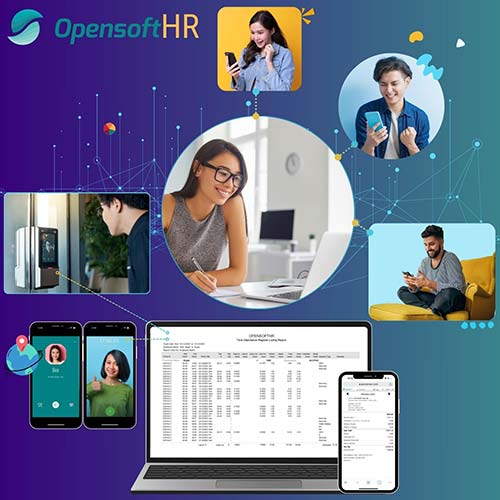
Built specifically for operational industries including construction, marine, and manufacturing. Key strengths for construction teams include multi-site attendance with GPS and QR clocking, foreign worker payroll with levy and CPF handling, a dedicated Job Costing module that allocates labour costs to project codes, and an AI-powered employee assistant (AIME) for routine HR queries. PSG pre-approved (IMDA). Two-time Gold winner at the HR Vendors of the Year Awards.
Best for: Construction, marine, manufacturing, and facilities management SMEs with foreign worker headcount, multi-site operations, or project-based cost tracking needs.
Info-Tech HRMS
A Singapore-based HRMS with over 23,000 customers that covers payroll, time attendance, leave, claims, and project cost management in an integrated suite. The platform lists construction as one of its target industries and includes a mobile attendance app. PSG pre-approved (IMDA).
Best for: SMEs across a range of industries wanting an all-in-one HR and accounting platform with local support.
Talenox
A Singapore-built cloud payroll and leave platform focused on MOM compliance, CPF, and IRAS submissions. Clean interface suited to smaller teams. Does not include job costing or multi-site attendance as core features. PSG eligible.
Best for: Smaller construction admin teams that need reliable payroll and leave management without complex site operations requirements.
Payboy
A locally built HRMS with payroll, rostering, and mobile self-service. Targets SMEs in F&B, retail, and general service industries. Handles CPF, SDL, and IRAS AIS submissions. Less tailored to construction-specific requirements such as foreign worker levy management or job costing at the project level.
Best for: SMEs with simpler HR requirements or those in non-construction sectors looking for an affordable starting point.
QuickHR
A Singapore cloud HRMS covering payroll, time, leave, and rostering. Used across SME to mid-market segments. Offers mobile self-service and integrations with Xero and QuickBooks. Construction-specific modules such as job costing are not listed as core features. PSG pre-approved.
Best for: Growing SMEs wanting integrated payroll and attendance without heavy industry-specific requirements.
How to Evaluate Vendors
When shortlisting vendors, ask these questions during demos:
- How does your system handle payroll for a mix of Singapore Citizens, PRs, and Work Permit holders on the same project?
- Can I assign workers to projects and pull a labour cost report per project?
- How does attendance clocking work on a site with no stable Wi-Fi?
- How long does implementation take, and what does it involve?
- How quickly do you update the system when CPF or levy rates change?
Reputable Singapore-based vendors will have direct, specific answers to all of these. Vague responses should be treated as a red flag.
Frequently Asked Questions
Q: Can generic payroll software handle foreign worker levies and CPF correctly?
Some can, but it depends on how well-maintained the Singapore compliance rules are. Generic platforms with global user bases often lag behind local regulatory updates. Verify whether the vendor has a dedicated Singapore compliance team and how quickly they pushed the last CPF ceiling change.
Q: What is the difference between time attendance software and HR software for construction?
Time attendance tracks when workers are on site. HR software combines this with payroll processing, leave management, and employee records. For construction, the two need to be tightly integrated so that attendance data flows directly into payroll without manual re-entry – manual handoff is a common source of payroll errors.
Q: How do I track labour costs per project without a dedicated system?
Most companies doing this manually use timesheets submitted by supervisors, then consolidate in Excel. This works at small scale but breaks down quickly as project count or headcount grows. Errors in timesheet allocation directly distort project profitability figures and make future tender pricing unreliable.
Q: Is HR software expensive for a small construction company?
Pricing varies, but many Singapore vendors use per-employee per-month models, which means costs scale with headcount. For companies eligible for the PSG grant, the net cost after the 50% subsidy can make even full-featured systems affordable. It’s worth requesting a quote with and without PSG applied.
Q: What HR software do construction companies in Singapore use?
Commonly evaluated platforms include OpenSoftHR, Info-Tech HRMS, Talenox, Payboy, and QuickHR. Of these, OpenSoftHR and Info-Tech HRMS include job costing and are explicitly positioned for construction. Talenox, Payboy, and QuickHR are broader SME platforms suitable for construction companies with simpler requirements. See the comparison section above for a breakdown.
See How OpenSoftHR Handles Construction Payroll
OpenSoftHR is built for Singapore’s construction sector. From multi-site attendance and foreign worker payroll to job costing and MOM compliance, the platform is used by construction companies to reduce manual HR work and stay audit-ready.
Request a demo to see the full system in the context of your workforce.