Home
Home
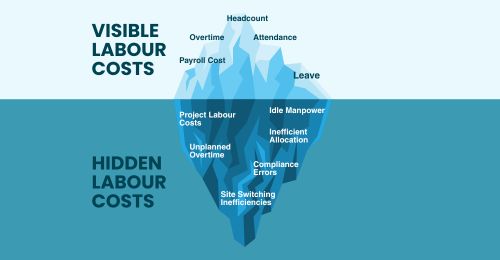
The Visible 20%
Most construction firms believe they have a clear understanding of their labour costs.
They track:
-
who showed up on site
-
the hourly wage of each worker
-
when workers clock in and out
On the surface, this seems like enough to control labour spending.
But in reality, these numbers often represent only a small portion of the true labour cost picture.
In many construction projects, the real risks lie in operational blind spots. These are inefficiencies that traditional timesheets and basic punch-clock systems rarely capture.
And it is in these blind spots where project margins quietly disappear.
Where Construction Labour Costs Actually Escalate
When a project exceeds its labour budget, it is rarely due to a single dramatic mistake.
More often, costs rise because of small operational inefficiencies repeated across hundreds or thousands of labour hours.
Some of the most common sources of labour cost leakage include the following.
The Materials–Labour Gap
A crew of ten workers arrives on site at 8:00 AM ready to begin work.
But the materials needed for their task do not arrive until 10:30 AM.
Two hours of idle labour across a single crew may seem insignificant. However, when similar delays occur across multiple sites over the course of a project, the financial impact compounds quickly.
Idle time is rarely visible in standard labour reports, yet it quietly inflates project costs.
Unplanned Overtime Creep
Construction projects frequently require overtime to meet tight deadlines or recover from unexpected delays.
However, overtime decisions often happen on the ground. They are authorized by supervisors who are trying to keep progress moving.
By the time overtime records reach the back office through timesheets or payroll processing, the additional labour cost has already accumulated. Without real-time visibility, project managers lose the opportunity to rebalance manpower earlier.
The Site-Switching Leak
In many companies, workers are frequently moved between multiple project sites.
While this flexibility helps keep projects moving, it also introduces complexity in tracking labour allocation.
If worker hours are not tagged to the correct project at the moment they are worked, labour costs must later be reconstructed manually. This makes it difficult to produce accurate actual-versus-estimated labour cost reports and weakens project cost control.
Compliance and Allowance Errors
Construction work often involves complex rules around shift allowances, travel claims, or site-specific pay structures.
When these calculations rely on manual processes, errors become more likely.
Overpayments gradually inflate labour costs, while underpayments may expose companies to compliance risks or worker disputes.
Why Traditional Systems Struggle
Many construction companies rely on fragmented systems to manage workforce data:
-
attendance tracking on one system
-
project costing on another
-
payroll handled separately
When these systems are disconnected, labour information must be consolidated manually at the end of the reporting cycle.
By the time management reviews labour cost reports, the data reflects what has already happened instead of providing visibility early enough to influence operational decisions.
The Role of Job Costing in Labour Cost Control
For many construction companies, labour costs become difficult to control because workforce hours are not consistently tied to specific projects or tasks.
This is where job costing systems play a critical role.
Job costing allows companies to assign labour hours directly to project codes, work stages, or specific activities. Instead of seeing labour costs only at the payroll level, managers can see exactly where manpower hours are being spent within each project.
When labour hours are not tracked at this level of detail, cost overruns often appear only after payroll is processed or after project reports are generated.
By that point, the opportunity to correct manpower allocation has already passed.
Why Labour Cost Visibility Matters
In labour intensive industries such as construction, manpower costs can account for a significant portion of overall project expenses.
Without accurate labour cost tracking, project managers are often forced to rely on estimates or delayed reports when evaluating whether a project remains within budget.
Improving labour cost visibility allows companies to:
-
identify inefficiencies earlier
-
detect overtime spikes before they escalate
-
allocate manpower more effectively across projects
-
improve the accuracy of future project tenders
When labour cost data is connected directly to site activity and project costing, companies gain far greater control over how workforce spending evolves throughout the project lifecycle.
Surfacing the Hidden Operational Costs
Controlling construction labour costs requires more than simply tracking attendance.
It requires visibility into how labour hours relate to projects, tasks, and real time site activity.
This means creating a unified data flow where:
-
site attendance is validated through location based tracking
-
project allocation happens at the point of clock in
-
overtime approvals become visible to management as they occur
-
labour hours are tied directly to specific projects or cost codes
When workforce data flows through a single platform, companies gain the ability to identify patterns that were previously hidden. These may include recurring idle time, overtime spikes, or manpower allocation inefficiencies.
Platforms like OpensoftHR are designed to provide this operational visibility, allowing construction firms to monitor labour activity across projects and respond earlier when costs begin to drift beyond plan.
The Bottom Line
Construction labour costs are rarely lost through a single decision.
They disappear gradually through small inefficiencies repeated across large workforces and long project timelines.
Companies that gain visibility into these operational patterns and act on them early are far better positioned to protect project margins and improve labour cost control.
Understanding and managing these hidden inefficiencies is often the difference between projects that merely stay busy and projects that remain truly profitable.