Home
Home
Most Singapore SMEs shortlist the same three or four names. This guide compares them on the criteria that actually matter: MOM compliance, PSG Grant eligibility, workforce management depth, vertical fit for project-based industries, and what you’ll actually pay after grants.
Why the right shortlist matters
For a 50-person SME, the wrong HRMS means migration pain, a second implementation cost, and staff re-training. The platforms competing for your attention in Singapore are not the same product at different price points. They are built for different buyers.
This guide covers four of the most commonly evaluated HRMS platforms for Singapore SMEs in 2026: InfoTech, QuickHR, JustLogin, and OpenSoftHR. Each has been evaluated against five criteria:
- MOM and CPF compliance (auto-calculation, IR8A, payslip requirements)
- PSG Grant eligibility (IMDA SMEs Go Digital pre-approved status)
- Attendance capture: biometric, mobile, and multi-site
- Vertical fit for project-based industries (construction, marine, engineering)
- Total cost of ownership for a 50-employee Singapore SME
One upfront note: this article is published by OpenSoftHR. We’ve tried to represent competitors accurately and fairly, but you should know the source and weigh it accordingly.
Quick comparison
| InfoTech | QuickHR | JustLogin | OpenSoftHR | |
|---|---|---|---|---|
| MOM/CPF compliance | ✅ Full | ✅ Full | ✅ Full | ✅ Full |
| PSG Grant pre-approved | ✅ | ✅ | ✅ | ✅ |
| Biometric device integration | Partial | Partial | Partial | ✅ Native |
| Mobile attendance (GPS) | Limited | ✅ | Limited | ✅ Native |
| Job Costing module | ❌ | ❌ | ❌ | ✅ |
| Foreign Worker Management | ❌ | ❌ | ❌ | ✅ |
| AI HR Assistant (HRMS-native) | ❌ | ❌ | ❌ | ✅ AIME |
| Construction/Marine vertical | General | General | General | Specialist |
| Price (per employee/month) | ~$2/module | ~$5 | Not public | From $2/module |
| Years in SG market | 18+ | ~8 | 10+ | ~10 |
Criteria 1: MOM and CPF compliance
All four platforms covered here meet Singapore’s statutory requirements: CPF auto-calculation, IR8A generation, and itemised payslips under the Employment Act. This is now table stakes for any established HRMS vendor in Singapore. Among the four covered here, compliance is not a differentiator.
Criteria 2: PSG Grant eligibility
All four platforms are pre-approved under IMDA’s SMEs Go Digital programme. The 50% subsidy applies to qualifying packages for Singapore-registered SMEs with at least 30% local shareholding and a minimum of 15 employees.
The grant reduces costs equally across all options. The more meaningful question is which platform is actually built for your workforce, not which is cheapest before subsidies.
Criterion 3: Attendance capture (where most payroll errors begin)
For office-based businesses, attendance is straightforward. For site-based businesses in construction, marine, engineering, or F&B, it is not.
Workers are spread across multiple locations. Timesheets are filled in manually, submitted late, or lost. Supervisors sign off on hours they didn’t personally verify. By the time payroll runs, HR is reconciling discrepancies rather than processing clean data. The result is payroll errors, overtime disputes, and MOM compliance exposure. All of it traces back to the same upstream problem: attendance data that was never captured accurately in the first place.
The right HRMS addresses this at the point of capture, not at the point of payroll processing.
Biometric devices
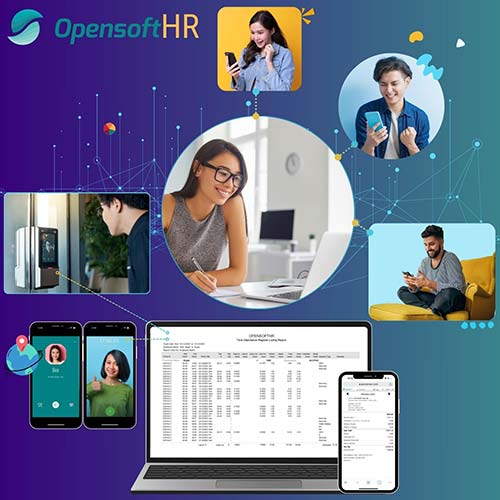
Hardware-level attendance capture eliminates buddy punching and manual timesheets. OpenSoftHR supplies and integrates biometric terminals directly, and also integrates with devices you already have. InfoTech, QuickHR, and JustLogin offer varying degrees of third-party device integration, but biometric hardware is not a native part of their product stack.
Mobile attendance with GPS
For workers at sites where fixed terminals aren’t practical, such as marine vessels, remote construction sites, or multiple project locations, GPS-verified mobile clock-in provides the same accuracy without hardware. OpenSoftHR’s mobile attendance is built into the core system, with clock-in data feeding directly into payroll and job costing. QuickHR also offers mobile attendance; JustLogin and InfoTech have more limited mobile clock-in capability.
The practical difference: when attendance data flows from device or mobile app directly into payroll, manual reconciliation is largely removed. When it doesn’t, someone in HR is doing that work every fortnight.
Criterion 4: Vertical fit for project-based industries
For general office-based businesses with standard payroll, all four platforms are adequate. The gap opens for companies in construction, marine, offshore, or engineering, where general HRMS platforms don’t address certain requirements as core features.
Job Costing
Companies billing clients by project need to know which workers were on which project, for how many hours, at what labour cost. Total headcount payroll is not enough. Without per-project visibility, project profitability is estimated rather than measured, and progress claims are built on approximations.
InfoTech, QuickHR, and JustLogin do not offer a Job Costing module. OpenSoftHR links Time & Attendance data directly to project codes and generates per-project labour cost reports within the HRMS, without requiring a separate system or manual export.
Foreign Worker Management
For companies managing Work Permit and S Pass holders alongside local staff, the compliance overhead is significant: levy calculation, work pass expiry tracking, MOM reporting, and headcount ratio management. Errors here carry real penalties.
General HRMS platforms treat foreign workers as a payroll variant. OpenSoftHR includes a dedicated Foreign Worker Management module that tracks pass types, expiry dates, and levy obligations as part of the core system.
Rotation scheduling
Offshore and marine workforces often run 14/14 or 28/28 rotation schedules. Standard leave and attendance modules aren’t designed for these patterns, which creates leave calculation errors and scheduling gaps. OpenSoftHR handles rotation-aware scheduling natively.
If none of these apply to your business, this criterion doesn’t differentiate your shortlist.
How each platform compares
InfoTech
Best suited to: Larger SMEs and mid-market companies that prioritise compliance certifications and institutional credibility.
Strengths: Strongest certification stack in this comparison. Large customer base and institutional stability. PSG pre-approved.
On AI: InfoTech has launched an AI assistant, but it sits within their CRM product, not the HRMS. Employees and HR admins using the core HR platform have no AI assistant available to them. This distinction matters if reducing HR admin workload is part of your evaluation criteria.
Limitations: Horizontal positioning means no vertical depth for construction, marine, or engineering-specific workflows. No Job Costing module. No Foreign Worker Management module. Biometric and mobile attendance rely on third-party integrations rather than native capability. Per-module pricing stacks up at full suite. Support at scale is ticket-based rather than named account management.
Pricing: From ~$2/module/employee/month. PSG packages available.
Bottom line: The strongest choice on certifications and compliance credentials. The right fit for businesses that need maximum institutional credibility and whose workforce is primarily office-based.
QuickHR
Best suited to: Mid-market companies that want a polished all-in-one platform and are comfortable at a higher per-head price point.
QuickHR has strong brand presence in Singapore with 195,000+ claimed users. ISO certified and PSG pre-approved, the product is well-regarded for its mobile app and clean interface.
Strengths: Strong market presence. ISO certified, PSG pre-approved. Mobile attendance with GPS available. Clean interface with a lower administrative learning curve.
Limitations: No Job Costing module. No Foreign Worker Management module. No AI HR assistant. At ~$5/employee/month, the entry price is higher than module-based competitors at equivalent headcount. No vertical specialisation for project-based industries. Rotation scheduling is not a core feature.
Pricing: From ~$5/employee/month across three tiers. PSG Grant eligible, with net cost after 50% subsidy at approximately $2.50/employee/month. Note: QuickHR’s advertised “from $2/month” pricing appears to reflect a starter or solo tier. Verify current SME plan pricing directly with QuickHR before using this figure for budget comparisons.
Bottom line: A good fit for general office-based businesses that want a complete, easy-to-use HRMS. Less suited to project-based industries or businesses with significant foreign worker or multi-site complexity.
JustLogin
Best suited to: General-industry SMEs with standard payroll needs and no vertical-specific requirements.
JustLogin is a Singapore cloud HR platform with over a decade in market. It covers the standard HRMS module set: payroll, leave, claims, and time and attendance, with a local compliance focus and PSG eligibility.
Strengths: Established Singapore platform. PSG pre-approved. Covers core HRMS modules cleanly. Local compliance focus.
Limitations: Pricing is not publicly disclosed, which adds friction to a direct evaluation. No Job Costing module. No Foreign Worker Management module. No AI HR assistant. Limited biometric and mobile attendance capability. No vertical specialisation.
Pricing: Not publicly listed. PSG Grant eligible. Request a quote directly from JustLogin for accurate figures.
Bottom line: A reasonable shortlist candidate for general-industry SMEs with standard requirements. The absence of public pricing means a sales engagement is required before you can make a meaningful cost comparison.
OpenSoftHR
Best suited to: Singapore SMEs in labour intensive industries such as construction, marine, childcare, retail, or engineering, particularly those managing foreign workers, billing clients by project, operating across multiple sites, or carrying significant HR admin overhead from manual processes.
OpenSoftHR is a Singapore-built HRMS designed specifically for SMEs in project-based and site-based industries. Its core differentiators are Job Costing, native biometric and mobile attendance, Foreign Worker Management, and AIME. These address the operational complexity that general platforms adapt for rather than build for.
Attendance capture: OpenSoftHR supplies and integrates biometric terminals directly, and also integrates with existing devices. For multi-site or remote workforces, GPS-verified mobile clock-in captures attendance without hardware. Both feed directly into payroll and job costing, removing the manual reconciliation step that drives most payroll errors in site-based businesses.
Job Costing: Time & Attendance data links directly to project codes. HR and operations managers get per-project labour cost reports within the HRMS, without a separate system or manual export. For businesses billing clients by progress claim or project contract, this replaces estimation with actual data.
Foreign Worker Management: Work Permit and S Pass holders are tracked within the core system, covering pass types, expiry dates, levy obligations, and MOM headcount ratios. Compliance is built into the workflow rather than managed as a separate manual checklist.
AIME (AI HR Assistant): Employees can query their own leave balances, payslip items, and claims status directly through AIME, without routing through HR admin. AIME reads live system data, so answers are accurate rather than approximate. For HR teams already stretched by site-based operational complexity, reducing routine query volume has a practical impact on admin workload.
Named clients: Sanwah Construction Pte Ltd, Juan Kuang Pte Ltd, and Dragon Offshore Engineering Pte Ltd, alongside general-market clients including ComfortDelGro, Doctor Anywhere, and Thai Express.
Strengths: Job Costing module for project-based billing. Native biometric device supply and integration. GPS mobile attendance. Foreign Worker Management module. Rotation-aware scheduling (14/14, 28/28). AIME AI assistant for routine HR queries. Named account management. PSG pre-approved. From $2/module/employee/month.
Limitations: Smaller customer base and fewer certifications than InfoTech. Newer brand visibility in search results compared to InfoTech and QuickHR.
Pricing: From $2/module/employee/month (minimum 2 modules, minimum 15 employees). One-time setup: $400/module. Enterprise perpetual licence from $6,300 (25 employees). PSG Grant eligible, with up to 50% subsidy on qualifying packages.
At 50 employees, 3 modules (Payroll + Leave + Claims):
- List price: $300/month
- After 50% PSG Grant: ~$150/month net
- vs QuickHR at ~$5/employee: $250/month (after grant: ~$125/month)
Bottom line: The specialist choice for project-based industries. If your business manages workers across sites, employs foreign workers, or bills clients by project hours, OpenSoftHR addresses operational complexity that general platforms don’t. For office-based businesses with standard payroll, InfoTech or QuickHR will serve standard HRMS needs adequately.
Summary
On MOM compliance and PSG eligibility, all four platforms are equivalent. At grant-adjusted rates, pricing is broadly comparable. The meaningful differences in 2026 come down to operational depth.
Attendance capture: Only OpenSoftHR offers native biometric device supply and GPS mobile attendance as part of the core product. For site-based businesses, this is where payroll accuracy starts or fails.
Job Costing: Only OpenSoftHR links Time & Attendance to project codes within the HRMS. For businesses billing clients by project, this removes a significant manual process and makes labour cost data reliable.
Foreign Worker Management: Only OpenSoftHR includes a dedicated module for Work Permit and S Pass tracking. For businesses with a mixed local-foreign workforce, compliance overhead is an ongoing operational cost that the right system should reduce, not add to.
Certifications and scale: InfoTech leads on institutional credibility and certification depth. For businesses subject to audit requirements or enterprise procurement criteria, this matters.
The right platform depends on which of these gaps applies to your business, not on which vendor has the most name recognition.
For Singapore-registered SMEs with 15+ employees, up to 50% subsidy is available via PSG Grant under IMDA SMEs Go Digital. See how OpenSoftHR fits your industry. Book a free 20-minute demo.